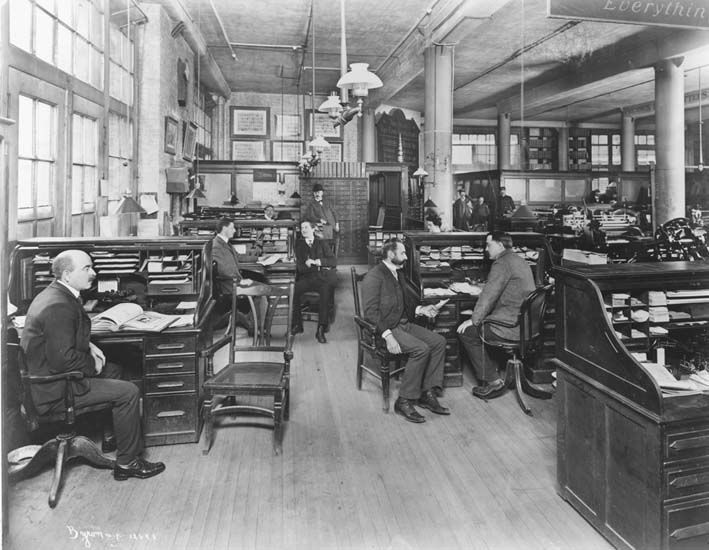
Frederick Winslow Taylor was regarded as the father of scientific management, and Taylor codified what he learned in a book, “The Principles of Scientific Management,” with the chief innovation being the application of the scientific method to maximize human performance. Applied to white-collar work, this produced the open plan office, rows of identical desks on large undivided floors, organized like a factory floor, because that is exactly what the thinking behind them was. The worker was a unit of output. The furniture supported that premise.
Then came the cubicle, and it was supposed to be an improvement.
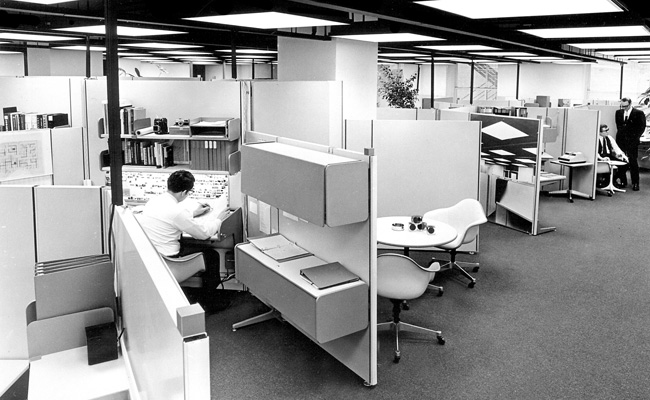
Robert Propst worked for Herman Miller in Ann Arbor, Michigan, hired to find problems outside of the furniture industry and conceive solutions for them. Propst’s research for the Action Office range meant drawing influence from a wide range of disciplines: biology, mathematics, and behavioral psychology. His design gave workers height-adjustable surfaces, vertical storage, and spatial separation without full enclosure. Propst’s goal for Action Office 2 was to be a flexible system to encourage what he called fortuitous encounters: spontaneous conversation, idea sharing, and so forth. It was, on paper, one of the most considered pieces of office furniture ever built.
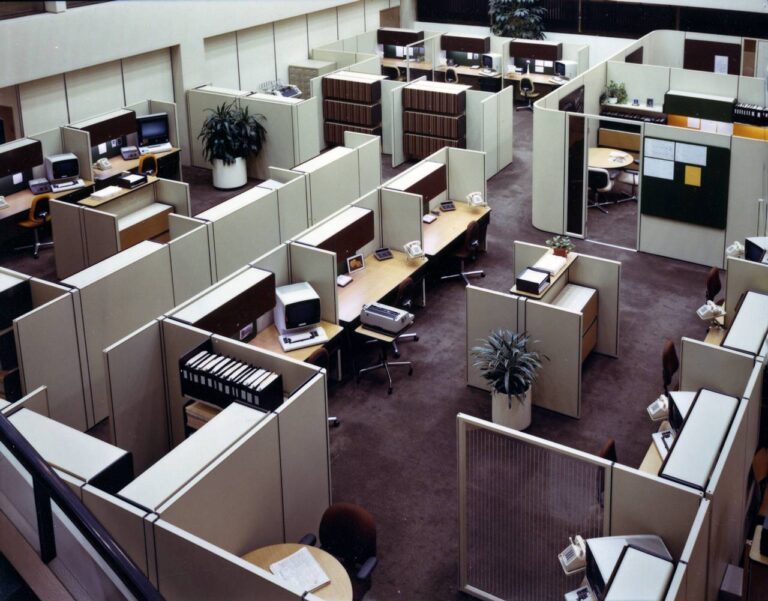
What companies did with it was build the cubicle farm.
In the 1960s, the U.S. tax code made one small but important change: businesses could now depreciate their office furniture over seven years, much faster than the 39.5 year rate for physical office walls. Under this system, companies could recover costs much more quickly on furniture, making it considerably cheaper than construction when it came to creating an office. The panels went up. The ceilings came down. The generous, movement-oriented workspace Propst had designed became a grey grid of enclosed workstations that offered the psychological weight of enclosure without any of its actual privacy. In 1997, Robert Propst said that he had hoped his idea would give knowledge workers a more flexible, fluid environment, but regretted that his idea had evolved into just that, saying that the cubicle-izing of people in modern corporations is monolithic insanity.
The tech industry arrived in the 1990s and declared the cubicle over, which was accurate, but the solution they reached for was simply to remove the panels and call it innovation. The open plan office returned, dressed in exposed concrete and reclaimed wood, rebranded as collaboration. The ping pong tables and the beer fridges and the lounge areas with Edison bulbs were not amenities in any functional sense. They were a visual argument that this was a different kind of company, a place you would want to be, a community rather than an employer. The furniture was doing ideological work.
Research caught up with the open plan eventually. Harvard University’s Ethan Bernstein and Stephen Turban’s research confirmed that open plan offices make it harder for managers to foster collaboration and collective intelligence among employees. Studying the interactions of two Fortune 500 multinational companies, both before and after their office was transformed from a traditional closed cubicle office to an open plan format, the study found a significant slump in face-to-face interaction time between staff, as well as a sharp fall in productivity. Rather than fostering greater face-to-face collaboration, open office architecture seemed to elicit social withdrawal from colleagues, with employees compensating for the lack of privacy by wearing large headphones to signal a “do not disturb” message. The design had optimized for the appearance of collaboration rather than the conditions that produce it. CMIMedium
Then the pandemic cleared the floors entirely, and the conversation shifted again.
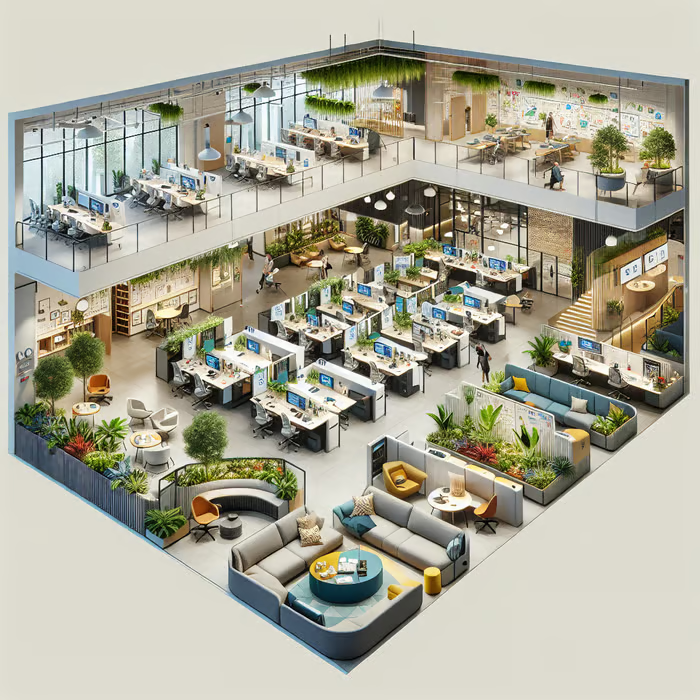
What came after 2020 was not a single answer but a series of competing proposals about what the office is even for now that the commute is optional and the laptop goes everywhere. Standing desks. Acoustic pods. Biophilic design with living walls and circadian lighting systems. Hot-desking and hoteling and activity-based working and every other framework for managing the fact that a fixed desk for every employee no longer makes economic sense when half of them are home on any given Tuesday.
The furniture industry responded with products that hedge every bet. Modular everything. Height-adjustable everything. Moveable walls and reconfigurable meeting rooms and lounge seating that can read as either a waiting area or a collaborative zone depending on how you arrange it. The office has become a space that refuses to commit to a single idea of what work looks like, because no one in a position of authority is willing to say what work actually is anymore.
Propst wanted to design furniture around how people worked. A century later, we are still designing furniture around how we want work to look. The desk has always been a statement about power. That part has not changed at all.