Create the Space. Create the Culture.

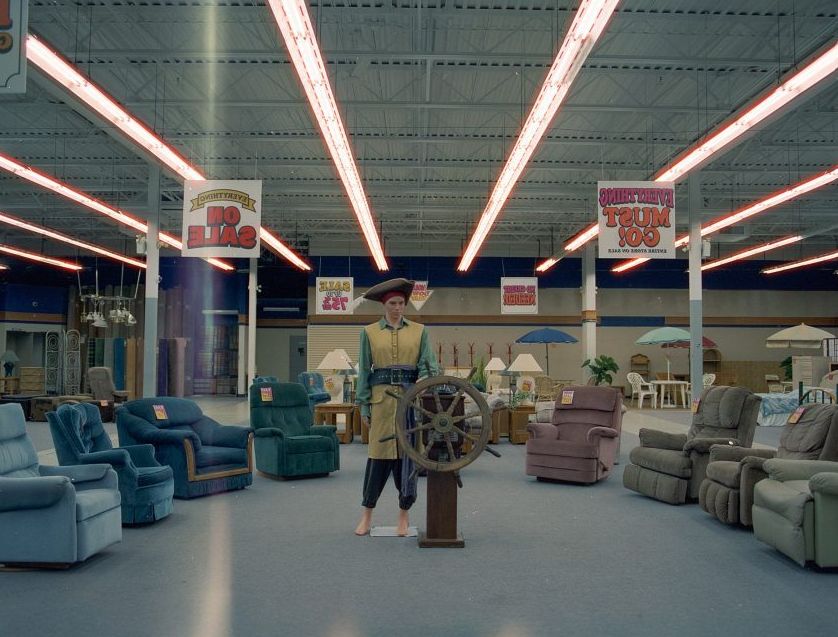
Cap’n Clark’s Ottoman Empire

There is a specific dread that lives inside a big box furniture showroom. You have walked through it without naming it. The living room with no walls. The dining table set for six, and the six will never come. The bedroom staged for sleep no one will have. Every vignette built to simulate domesticity, and every vignette failing at it in the same way. The objects are familiar. The arrangement is familiar. But the life that is supposed to animate all of it is not there, and nothing in the design asks you to look for it.

The Backrooms takes that discomfort and builds a film around it.

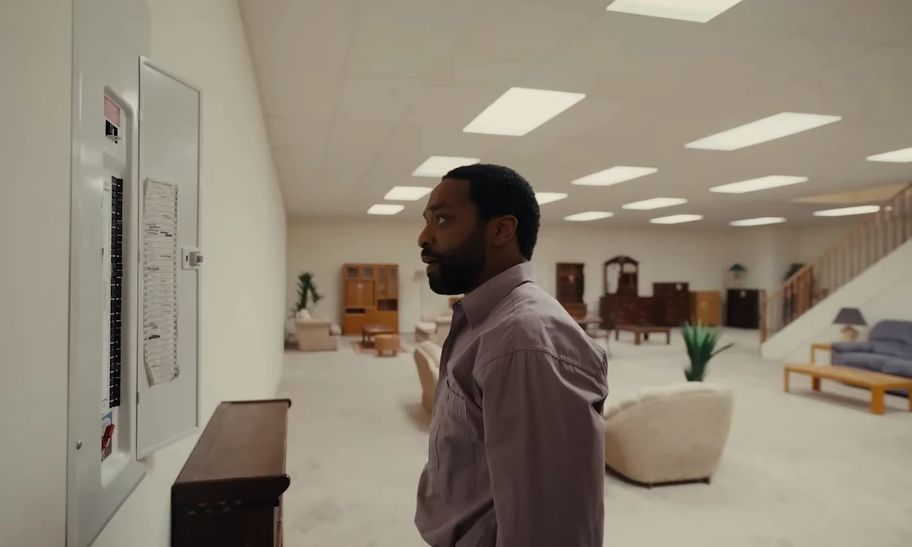
Set in the 1990s, the story follows Clark, a trained architect who has reached rock bottom and ended up running a discount furniture store, Cap’n Clark’s Ottoman Empire, a cavernous retail floor stacked with maple bedroom sets, bulging recliners, and everything a first-time homeowner might load onto a credit card. The showroom reads immediately as a place where domestic life is sold, but never actually practiced. That gap, between the idea of a home and the retail object approximating it, is where the film’s first layer of unease lives.

Then Clark goes below.

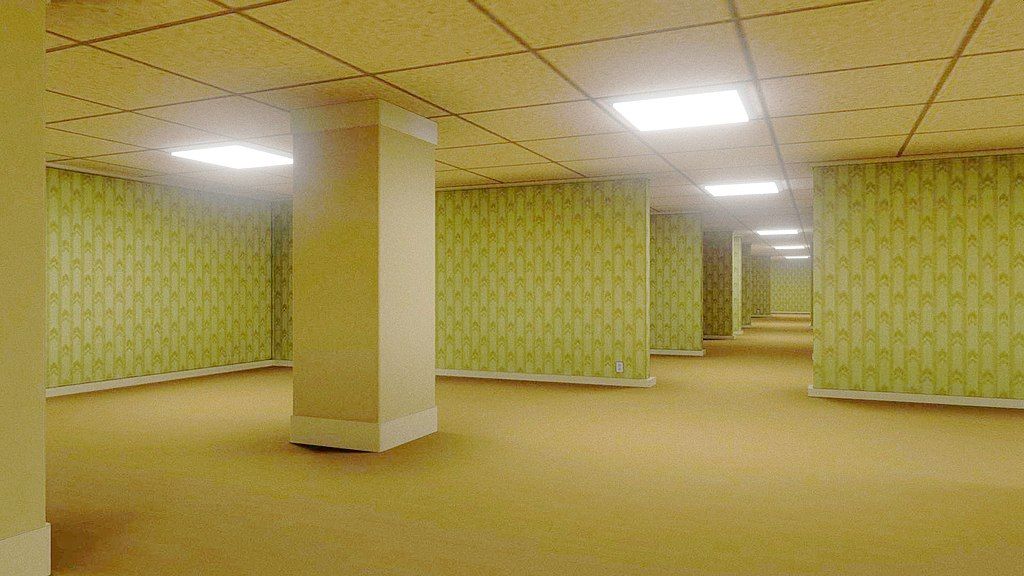
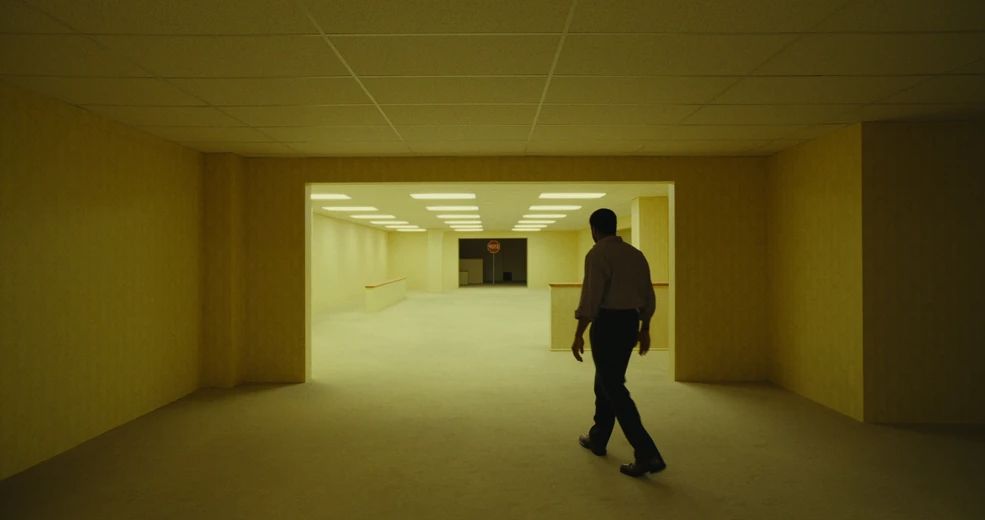
Electrical problems push him into a subterranean showroom, and from there into the backrooms: an unbounded liminal space defined by yellow walls, wet carpet, and fluorescent ceiling grids that flicker on a delay that feels personal. The architecture is filled with long corridors and misplaced doors. Rooms arranged at wrong angles. Passages that require crawling to enter. The space reads like a building that was designed by someone who had heard a description of a building, but had never been inside one. 

What makes The Backrooms visually interesting is the decision to make it cheap on purpose. The same mono-yellow wall treatment, the same repeating partition system, the same institutional carpet grid, running forever, never resolving. No finish level, no hierarchy, no material surprise. The architecture has been value-engineered so aggressively that all spatial logic collapsed, and what is left is the skeleton of a commercial interior with nothing inside it that means anything. Its the budget spec sheet as an infinite nightmare. Empire 

We design commercial interiors people actually want to be in.

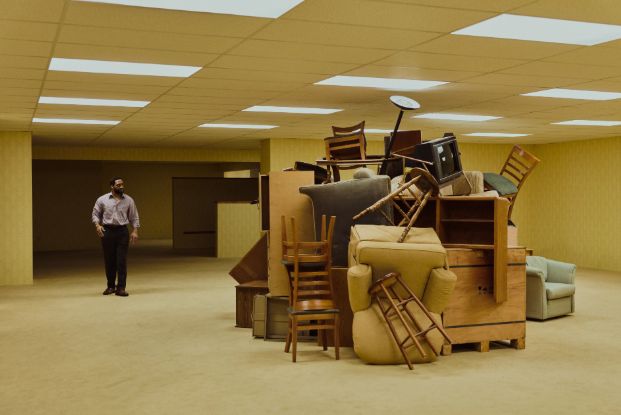
The furniture continues here, too. Scattered, broken, distorted. In the showroom above, the furniture was staged to suggest a life. Down here, the furniture is simply debris. It has lost its function and kept its form, which makes it stranger than if it had disappeared entirely. At certain moments it begins to melt. That is when you know the space has become hostile. 

The horror the film is working with is not supernatural in the traditional sense. It draws from the accumulated wrongness of everyday commercial space, the airport terminal at 3 AM, the hospital corridor on a Sunday, the IKEA floor map that stops making sense four rooms in. Spaces that were designed to move people through them efficiently, with no interest in what those people might actually feel while they were moving. The backrooms is what happens when that spatial logic is extended without end and without exit. 

Clark’s architecture background is the correct lens for this story. He was trained to design the very category of space that is consuming him. The showroom he runs is a corrupted version of the residential interiors he was supposed to build. And the backrooms is a corrupted version of the commercial interior he settled for. Every layer of the film is a degraded copy of something that was supposed to be better, and that formal logic runs all the way down to the carpet. 

The Backrooms is a film about what happens when you strip designed space of the human intention behind it, and what you find when the intention is gone and becomes something much worse.

Ready to find your "blue space"?

Contact bluespace interiors today to schedule a consultation and transform your workplace!